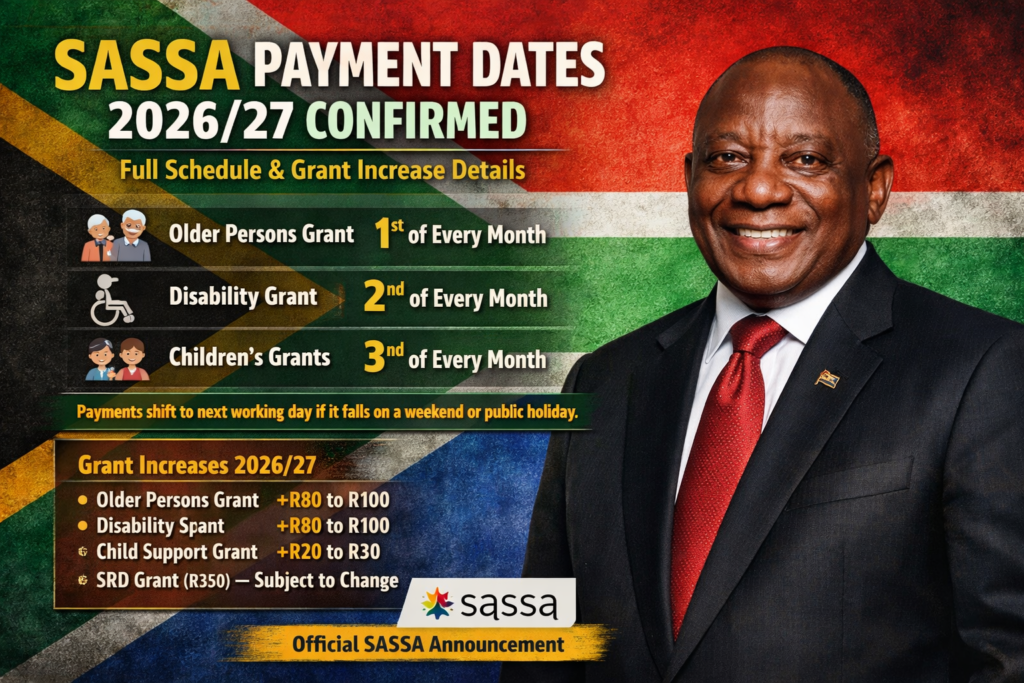
South Africa’s Department of Social Development (DSD) has officially gazetted changes to the country’s social grant system, set to take effect on 1 April 2026. These changes, which were previously announced by Finance Minister Enoch Godongwana during the 2026 Budget Speech, will see increases in various social grants, ensuring continued support for millions of South Africans.
Social Grant Increases for 2026
The increases in social assistance grants will range from R20 to R80 per month, benefiting a large portion of South Africa’s population. The most notable update is the continuation of the Social Relief of Distress (SRD) grant, which will remain at R370 per month, with payments extending until 31 March 2027.

The total allocation for social grants in the 2026/27 financial year is R292.8 billion, which accounts for 3.6% of South Africa’s GDP. The SRD grant will receive an additional R36.4 billion to extend payments at the current rate. These funds are crucial as they provide support for vulnerable individuals across the country.
Increase in Social Grant Allocations
Excluding the SRD grant, the overall spending on social grants is set to rise. In 2025/26, the total amount allocated to social grants stands at R246.6 billion, while in 2028/29, it is projected to increase to R276.5 billion. This increase reflects the government’s commitment to social protection, even in the face of financial constraints.
Currently, around 8.2 million people benefit from the SRD grant, and there are a total of 26.5 million grant recipients across South Africa. These increases are part of the government’s strategy to ensure that those in need have access to essential support.
Social Relief of Distress (SRD) Grant and the Transition to a Jobseeker’s Grant

A significant change to the SRD grant is its transition into a Basic Income Support (BIS) grant by 2027. This shift will turn the SRD grant from a temporary relief measure into a permanent tool for addressing unemployment in South Africa. The DSD has been working with the National Treasury on this new grant, and consultations are expected to be finalised by the end of March 2026.
President Cyril Ramaphosa confirmed that the BIS grant would become a jobseeker’s grant, aimed at helping unemployed individuals find work and sustain a livelihood. The goal is to link beneficiaries aged 18 to 59 with opportunities for employment, training, and entrepreneurship, transforming grants from survival tools into mechanisms for empowerment.
Ramaphosa emphasized the importance of strengthening South Africa’s social protection system and tackling the country’s high unemployment rate through this grant. The BIS will play a key role in supporting individuals as they search for employment and develop sustainable livelihoods.
Details of the Grant Increases
Here are the updated values for key social grants in 2026:
- Older Persons Grant: Increased from R2,320 to R2,400 (+R80)
- Older Persons 75+ Grant: Increased from R2,340 to R2,420 (+R80)
- War Veterans Grant: Increased from R2,340 to R2,420 (+R80)
- Disability Grant: Increased from R2,320 to R2,400 (+R80)
- Foster Care Grant: Increased from R1,250 to R1,290 (+R40)
- Care Dependency Grant: Increased from R2,320 to R2,400 (+R80)
- Child Support Grant: Increased from R560 to R580 (+R20)
- Child Support (Top-Up): Increased from R560 + R280 to R560 + R290 (+R20 + R10)
- Grant-in-Aid: Increased from R560 to R580 (+R20)
- SRD Grant: Remains at R370
The increases will be implemented on 1 April 2026, with another adjustment scheduled for 1 October 2026. Foster Care Grant beneficiaries will see a further increase to R1,300 from October 2026.
The Role of Social Grants in South Africa’s Economic Landscape
Social grants are a cornerstone of South Africa’s social development policy, representing the largest share of spending in this sector. The allocation of R292.8 billion for social grants reflects the government’s commitment to ensuring that the country’s most vulnerable citizens have access to essential support.
Despite the challenges faced by the South African economy, the government has prioritized social spending to ensure the continuation of grants, especially the SRD, which has become a lifeline for millions of South Africans.
Conclusion
The upcoming social grant increases set to take effect on 1 April 2026 highlight South Africa’s commitment to supporting its vulnerable citizens. With a focus on extending the SRD grant and transitioning to a jobseeker’s grant, these changes aim to provide not only immediate relief but also long-term empowerment.
The government’s efforts to strengthen the social protection system are crucial in addressing unemployment and ensuring sustainable livelihoods for millions of South Africans.